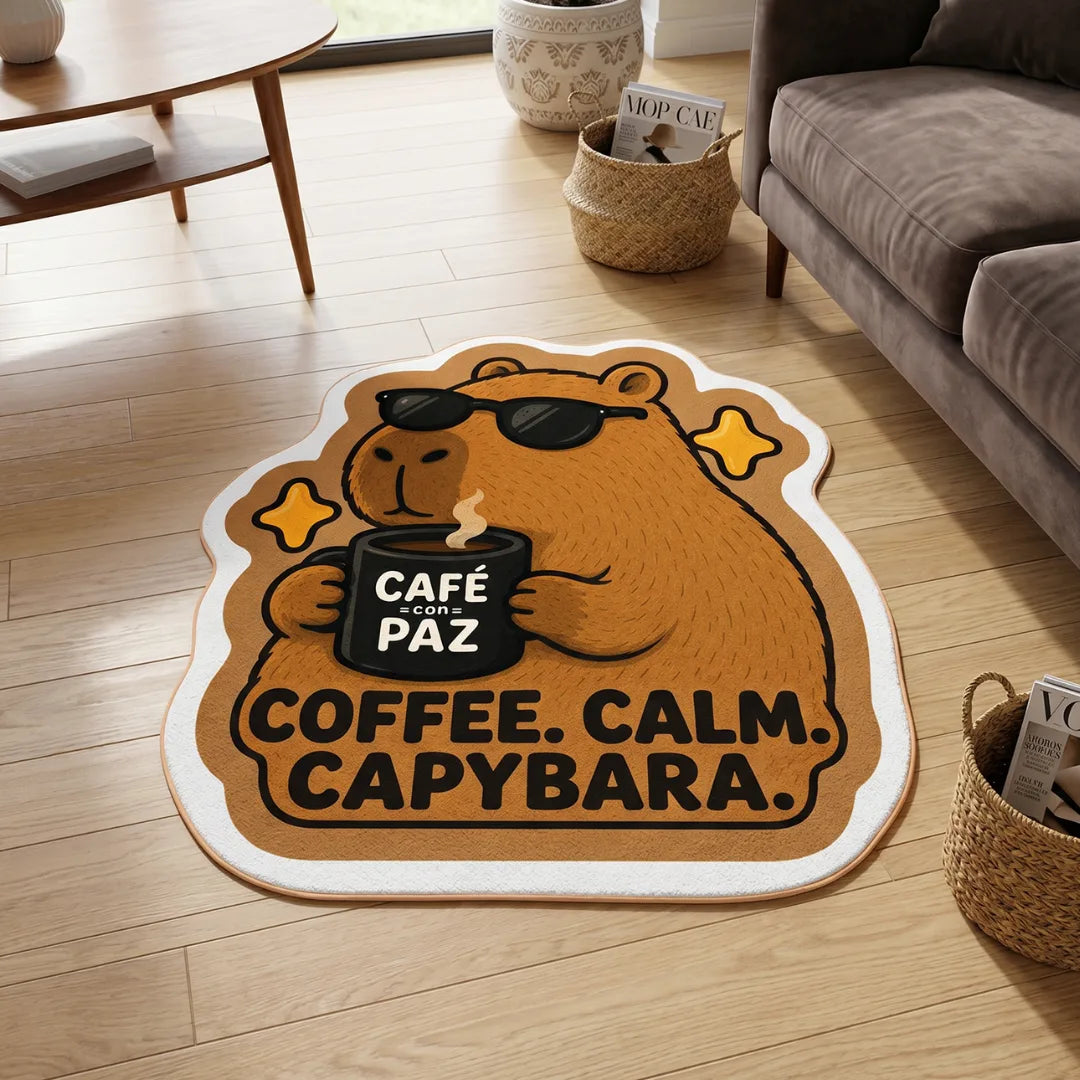

Interior designers have a saying that clients hear once and never forget: the rug is the room. Not the sofa. Not the lighting. Not the paint color. The rug. It is the single surface that holds everything else together, the piece that makes a seating arrangement feel intentional rather than accidental; a room feel finished rather than in progress; and a home feel lived-in rather than assembled.
And yet the living room rug is also the single piece most people get wrong. Too small. Too centered. Too cautious. Or, more often than any designer will admit out loud, never bought at all, because the size chart is confusing and the stakes feel too high.
This is the guide that removes all of that friction. What size living room rug you actually need, where to place it, why the shape matters, and what materials last. If you are comparing rug sizes across several rooms—not just the living room—start with our Rug Size Guide for U.S. Homes. This page stays focused on the living room.
The Most Common Living Room Rug Mistake (And Why Almost Everyone Makes It)
Before anything else, the rug is too small.
This is the near-universal mistake in American living rooms. A 5×8 rug in a room that needs an 8×10. A 4×6 floating in the middle of a space where the front legs of the sofa should be resting on a much larger surface. A rug that, rather than anchoring the furniture arrangement, hides under it like it's embarrassed to be seen.
The reason this happens is almost always price. Larger rugs cost more, and the jump from a 5×8 to an 8×10 — or from an 8×10 to a 9×12 — feels significant when you're standing in a showroom or scrolling a product page. So people buy smaller, tell themselves it will look fine, and then live for years with a room that never quite comes together. If you are deciding between two compact sizes, our 4x6 vs 5x7 rug comparison shows how much floor coverage actually changes.
Here is the honest version of the rule: in most living rooms, the rug should be bigger than you think it needs to be. It should feel generous. It should create a platform for the seating arrangement rather than tucking itself underneath it. The goal is for the room to feel held together, and a rug that's too small cannot do that, regardless of how beautiful the pattern is.
Open Floor Plan Living Rooms
Recommended approach: zone-define with a larger-than-standard rug or use shape to define the space
Open floor plans present a specific challenge because the "living room" has no walls to define it—the rug has to do that work alone. An undersized rug in an open plan looks like a mistake. An irregular shaped rug in an open plan looks intentional. The organic silhouette communicates that the shape was a design decision, not a default.
Living Room Rug Placement: The Three Rules Designers Actually Use
Once you have the right size, placement is what separates a good room from a great one.
Rule 1: The Front Legs Rule
The single most universally applicable placement guidance: the front legs of every major piece of furniture in the seating arrangement should rest on the rug. Not all four legs. Just the front two. This creates visual continuity across the arrangement—the rug pulls the furniture into a unified grouping—without making the room feel heavy or cluttered.
Rule 2: Center to the Seating, Not to the Room
Most people center their living room rug in the room. Designers center it in the seating arrangement. These are often the same thing, but not always — especially in open floor plans or rooms with off-center fireplace placements. The rug's job is to anchor the furniture, not to align with the walls.
Rule 3: Leave Breathing Room on All Sides
In a furniture-defined living room, you want 12–18 inches of bare floor visible between the edge of the rug and the wall on all sides. This breathing room is what makes a rug look placed rather than shoved. If your rug runs edge-to-edge, it stops reading as a rug and starts reading as wall-to-wall carpet, which is a different, and far less interesting, design decision.
Why Living Room Rug Shape Matters More Than Most Guides Acknowledge
Every major rug retailer sells rectangles. Rectangle guides fill the internet. Rectangle is fine.
But the living room is the one space in the home where a rug's shape has the most visible impact—because it is the one space with the most seating, the most sight lines, and the most visitors who will see it.
An irregular shaped living room rug—organic silhouette, freeform edge, a shape that follows a design intention rather than a factory default—does something a rectangle cannot: It communicates that the choice was made intentionally. The person who lives here thought about the floor, considered its shape, and chose something specific.
Irregular shapes can be useful when a standard rectangle fights the furniture layout or circulation path. For sofa, coffee-table and walkway decisions specifically, see Irregular Rugs for Modern Living Rooms: Size & Placement.
Living Room Rug Materials: What Lasts, What Doesn't, and What You're Actually Walking On
The material of a living room rug is the specification that determines whether you own it happily for six years or replace it in six months. Here is the honest breakdown:
Faux cashmere (what A Print Nest uses): Soft, plush construction that delivers genuine underfoot comfort—the kind that makes taking your shoes off at the front door something you look forward to. It photographs beautifully, maintains its pile with normal foot traffic, and provides the softness that makes a living room feel like a living room. Not the thin, pilling surface found on mass-market alternatives.
Wool: Durable, natural, and genuinely beautiful in traditional and transitional interiors. The downsides: heavy, expensive, harder to clean, and typically unavailable in custom sizes or non-standard shapes at accessible price points.
Polypropylene/synthetic: Common, cheap, durable in a perfunctory way. Photographs poorly, feels like what it is, and does not age gracefully. The default material in the $30–$80 range.
Jute/sisal: Texture-forward, great for natural and organic interiors, but rough underfoot and difficult to clean. Better as a layering rug under a softer accent piece than as a primary living room surface. If you are still comparing finished options, browse the Living Room Rugs collection.
Crystal velvet: The material category that floods Amazon search results—thin, pills quickly, ships from overseas, and looks better in the product photo than it does in your home. The reason a $25 rug costs $25.
Living Room Rug Color and Pattern: The Shortest Useful Guide Available
If your living room is already busy (patterned sofa, heavy art, lots of texture): Choose a rug with a solid or very low-contrast pattern. Let the rug settle the room rather than compete with it.
If your living room is minimal (neutral sofa, light walls, few accessories): This is where a bold rug—animal print, capybara, geometric, or bold color—earns its keep. The rug becomes the personality of the room, not just the floor.
If you want a statement without overwhelming: An irregular organic shape in a single color is the move. The shape is the statement; the color doesn't need to be loud to hold attention.
Color rules that actually hold up:
- A rug should contain at least one color already present in the room — furniture, art, or a throw. This creates cohesion without matching.
- Warm floors (honey oak, mahogany) pull toward warm rugs (terracotta, rust, warm gray). Cool floors (light ash, concrete, and gray tile) accept cool rugs naturally and warm rugs as contrast.
- When in doubt: blue and gray. This combination is the closest thing to a guaranteed choice that exists in living room rug design—versatile across virtually every interior style.
The A Print Nest Living Room Rug Difference
Every living room rug choice in the standard market involves a trade-off: size or price. Quality or speed. Customization or convenience. A Print Nest living room rugs are designed around these choices.
California-made. Not overseas crystal velvet. Made domestically with material selection and quality control that reflect it.
Faux cashmere softness. The surface you actually want to walk on, sit on, and lie on when you're watching a film on a Sunday afternoon.
Clear dispatch timelines. Ready-designed rugs ship within 3 business days after the order is placed; custom rugs ship within 3 business days after final design approval. Carrier transit time is additional.
Starting at $59. The price point that removes the barrier to buying correctly—the right size, the right shape, and the right material—rather than the safest, smallest, cheapest option, because the alternative felt like a commitment.
Irregular organic shapes. No one else does this at accessible price points for living room rugs. The shape options at A Print Nest do not exist anywhere else at this price.
Custom rug options: For a pet-photo design, use our custom pet rug product. For an unusual non-pet outline, original artwork or a special indoor rug idea, contact A Print Nest with your preferred shape and approximate finished dimensions. We can offer general design suggestions and review feasibility, but do not measure rooms or guarantee an exact space fit.
Living Room Rug Ideas: Five Concepts Worth Ordering Right Now
1. The Organic Statement on Hardwood An irregular shaped rug in a warm neutral—camel, terracotta, deep olive—placed on honey hardwood with front furniture legs resting on. The shape communicates intentionality. The color grounds the room. The hardwood frames it like a painting.
2. The Bold Animal in a Minimal Room A capybara rug, an eagle rug, a cat portrait rug—placed in a minimal living room with neutral furniture and white walls.
Let the rug be the entire personality of the room. This is the approach that guests photograph without asking permission.
3. The Persian in a Modern Interior: A red or blue Persian-style rug in an otherwise contemporary room.
The layered-decade look—rooms that feel assembled over time rather than ordered from a single catalog—is the defining domestic aesthetic of 2026.
4. The Layered Look: A large jute or sisal foundation rug, with a smaller A Print Nest faux cashmere rug layered on top at the coffee table. The layered look adds texture, depth, and the impression of a designed room rather than a furnished one.
5. A Personalized Rug Idea: If a standard rectangle doesn't suit the look of your seating area, consider an organic outline or artwork-led design. Use the Personalized Living Room Rugs guide for inspiration. For non-pet artwork or unusual indoor shapes, ask our team about possible custom options before ordering.
Related Living Room Rug Guides
- Rug Size Guide for U.S. Homes — whole-home sizing reference.
- How Big Is a 4x6 Rug? — exact dimensions and real-room scale.
- 4x6 Rug Size & Placement Guide — room-by-room placement.
- 4x6 vs 5x7 Rug — compare compact sizes.
- Irregular Shaped Rugs for Living Rooms — shape and inspiration.
- — living-room styling ideas and custom outline considerations
Frequently Asked Questions
What size rug is best for a living room?
For most American living rooms, 8×10 is the right starting point. Small rooms (under 12×15 ft) work well with 6×9; large rooms (over 15×20 ft) should move to 9×12 or larger. For compact spaces, see how a 4x6 rug looks at real-room scale before deciding whether you need to size up.
Should a living room rug go under the sofa?
Front legs on, back legs off. The front two legs of the sofa and any chairs in the arrangement should rest on the rug. This anchors the furniture visually without requiring the rug to be large enough to sit fully under every piece.
What shape rug is best for a living room?
Rectangle works in most spaces. If the room has floating furniture, angled walkways, or you want the floor itself to become a design feature, compare our irregular shaped rug ideas for living rooms.
How do I choose a living room rug color?
Choose a rug that contains at least one color already present in the room — furniture, art, or a textile. This creates visual cohesion. When in doubt, blue and gray is the most versatile starting point and works across virtually every interior style.
Is faux cashmere a good material for a living room rug?
A Print Nest's faux cashmere floor rugs offer a soft printed surface for suitable dry indoor living spaces. They are intended for gentle vacuuming and spot cleaning, not machine washing. Check the selected product's material, backing and care instructions before ordering.
How quickly does A Print Nest ship living room rugs?
Ready-designed rugs ship within 3 business days after the order is placed; custom rugs ship within 3 business days after final design approval. Transit to the contiguous U.S. typically takes an additional 3–7 business days after shipment.
Can I get a custom-sized living room rug?
Possibly. You can propose an indoor rug outline and approximate finished dimensions, then contact A Print Nest to confirm available options before ordering. We provide general shape suggestions, not room measurement or guaranteed exact fit.
The Floor Is the Room. Make It Count.
The living room is the room where your home is most visible—to guests, to yourself, to the life you're building in it. The rug is the piece that determines whether the room feels finished or unfinished, intentional or accidental, personal or generic.
A Print Nest offers ready-designed rugs and made-to-order designs crafted in California. If you have a non-pet custom outline or artwork idea for a dry indoor space, contact our team with the preferred shape and approximate finished size. We'll review what we can make before you order, without promising precise room fitting.
The living room rug you've been putting off can be ordered this week. There is no good reason to have the wrong one on your floor for another season.
Browse Living Room Rugs →
Ask About a Custom Indoor Shape →