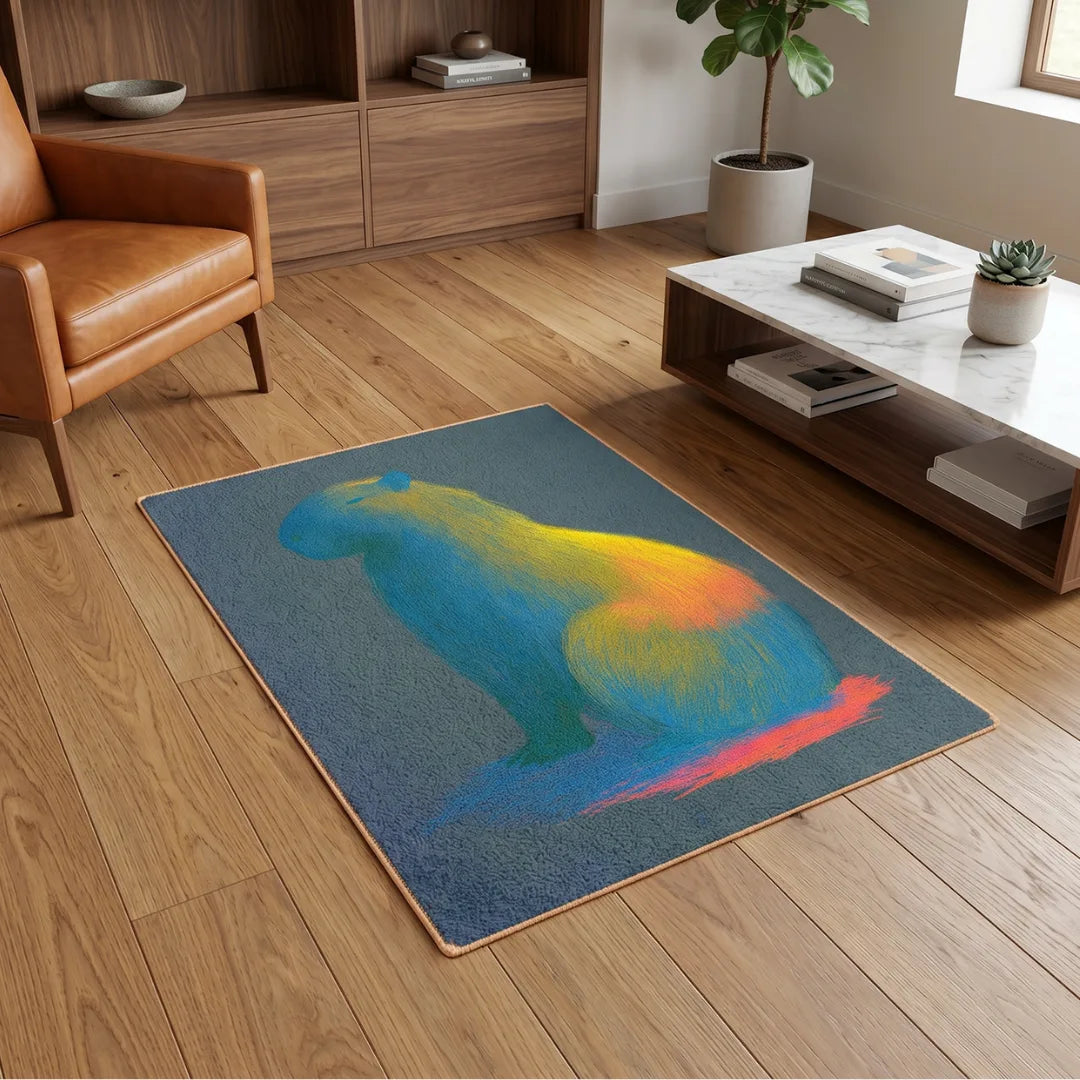

A rug doesn't have to be a rectangle, circle, or any other shape you would normally find in a home décor store. It might follow your dog's ears, the curves of a flower, your handwritten name, an authorized business logo, or a drawing you made yourself.
At A Print Nest, we believe the shape of a rug can be as personal as the artwork printed on it. But what does any shape really mean? Which outlines work best, and what needs to change when an illustration becomes a physical rug?
Quick answer: Custom-shaped rugs are not limited to a predefined list of design types. You can start with a photo, drawing, name, original illustration, authorized logo, abstract concept, or an idea not shown in this guide. We review each proposal for suitable size, material, artwork rights, and a shape that can be printed, cut, and edge-finished. Not every tiny detail can become a physical cut line. You can review the proposed design in a free digital proof before production.
What Does “Any Shape” Mean for a Custom Rug?
With a ready-designed irregular rug, you choose a shape that already exists. With a custom-shaped rug, your own photo, original artwork, drawing, authorized logo, or personal idea becomes the starting point for the outline.
The categories below are examples, not a menu of allowed customization types. If your idea doesn't match any of them, you can still share it with us for individual design review. The question is not which category it belongs to, but how to translate it into a suitable rug.
That doesn't mean tracing every pixel. Very narrow extensions, disconnected pieces, tiny cutouts, or sharp inward corners may need to be simplified so the finished piece can be made and finished neatly. The goal is to preserve what makes the design recognizable while creating a practical physical outline.
1. Pet-Shaped Rugs: Let the Pose Define the Shape
One of the most personal ways to plan a custom rug is to begin with a favorite pet photo. Upright ears create a different silhouette from floppy ears. A curled-up cat may form a compact outline, while a dog standing with separated legs can require more design adjustment.
- Face-shaped portraits: use recognizable ears, cheeks, and head shape.
- Full-body silhouettes: emphasize a sitting, lying, or standing pose.
- Multi-pet compositions: connect several portraits within one practical outline.
- Portrait-and-name layouts: place lettering within a shared shape rather than cutting tiny separate elements.
The best shape is not always the most complex one. Learn more in our custom pet-shaped rug ideas guide, or see how a pet's pose changes the finished outline.

2. Names, Handwriting, and Letter-Shaped Rugs
A name can become more than text printed inside a rectangle. Rounded letters, connected script, and overlapping typography can inspire the outside shape of a personalized rug.
But individual letters do not automatically form one connected textile. Small openings inside letters such as A, B, and O, thin pen strokes, and long narrow tails may need to remain printed details rather than physical cutouts. A connecting base or surrounding shape often makes a cleaner design.
For more examples of combining portraits, lettering, and shape, see our custom pet name rug design guide.

3. Flowers, Leaves, and Organic Silhouettes
Natural forms are excellent starting points for an unusual outline: rounded flower petals, a simplified leaf, a bouquet, or a free-flowing pebble shape. These designs can feel playful, sculptural, or understated depending on the artwork.
Keep very thin stems, tiny petals, and leaf veins inside the printed illustration when they would make the outside edge too delicate. A bold outer contour with detailed artwork inside can preserve the botanical look without requiring every fine line to become a cut.

4. Everyday Objects, Food, and Original Illustrations
Some of the most surprising custom rug ideas begin with everyday objects: a coffee spill, illustrated fruit, a camera, a paint palette, a hobby symbol, or a sketch from a notebook. Strong silhouettes are especially useful because they remain recognizable when scaled up.
For a coffee-spill-inspired design, for example, one connected puddle outline can carry smaller droplets as printed details. For fruit or a hand-drawn object, tiny seeds, buttons, strings, and surface textures generally work better as artwork inside the main shape.
Use artwork that you own or are authorized to reproduce. Familiar characters, logos, and protected images should not be copied without permission.

5. Business Logos and Creative Brand Shapes
A custom business rug does not have to print a logo inside a standard rectangle. Depending on the artwork, the shape might follow a round mark, a bold connected wordmark, a simplified graphic symbol, or a soft organic background.
For a business design, clear reading distance matters as much as the outline. Tiny lettering and narrow gaps can become difficult to reproduce at the finished size. Review the proportions, text, and proposed dimensions before approval.
See our custom logo rugs for small businesses guide and the real Ninoo Tech logo rug project for more context.

6. Custom Shapes for Unusual Rooms and Corners
Sometimes the starting point is not an image at all. It is a room with an angled layout, an awkward furniture arrangement, a bedside corner, or a small reading nook that does not suit a standard rectangle.
A curved or asymmetrical rug can visually define that space, but a custom shape cannot fix every floor-plan problem. Measure the available area, walking paths, furniture clearance, and any doors before ordering. An outline should complement the room rather than create a trip hazard or block circulation.
For practical examples, read small irregular-shaped rugs for apartments.
Why Choose a Particular Shape, and Where Can You Use It?
The outline does more than make a rug look unusual. It can remove unnecessary background from a personal photo, make an original design recognizable at a glance, soften a room full of straight furniture lines, or give a small space a clear focal point. The right shape depends on what you want people to notice and where the finished piece will go.
Pet silhouettes: keep the personality, not the photo's empty corners
Why this shape: A pet's ears, face, curled-up pose, or full-body stance becomes part of the finished edge, making the piece feel more personal than a rectangular photo print. Where it works: a pet corner, beside a reading chair, in a bedroom, or as wall art when you choose a compatible wall-rug product. A close-up often suits a head-shaped outline; a clear sitting or lying photo may suit a full-body silhouette.
Waves, clouds, and pebble shapes: soften straight-lined rooms
Why this shape: Rounded or flowing edges bring visual movement without needing a busy printed pattern. Where it works: beside a bed, by a lounge chair, in a reading nook, or as a small accent in an open living room. Leave part of the distinctive edge visible rather than hiding the entire shape under furniture.
Flowers, leaves, and organic artwork: let the illustration set the edge
Why this shape: The outline reinforces the subject, so a flower or leaf feels like its own piece of floor art rather than a picture inside a box. Where it works: a bedroom accent, studio, vanity corner, or decorative indoor area. Delicate stems and very narrow petals may need a simpler connected outline.
Names, letters, and authorized logos: make the message the focal point
Why this shape: A connected wordmark or recognizable logo silhouette emphasizes the name or identity itself. Where it works: gaming setups, creator studios, small-business display areas, and offices. For a wall display, use an appropriate wall-rug format. Small text and separated letter shapes may need to be printed within one practical cut shape; business artwork must be original or used with permission.
Long, narrow, or asymmetrical outlines: work with a particular footprint
Why this shape: A narrow curve or offset edge can create a visual accent without covering as much floor as a full rectangle. Where it works: alongside a bed, beside a console, or in a dry indoor hallway with sufficient clearance. Measure the widest points and test doors, furniture movement, and walking paths before ordering.
Original portraits and illustrations: display the art without a standard frame
Why this shape: An organic or subject-led outline can make a portrait, drawing, or original illustration feel like a standalone artwork. Where it works: a studio wall, personal gallery wall, or creator background when ordered as a suitable custom portrait wall rug. Wall displays and floor rugs have different construction and installation requirements, so choose the intended format before finalizing the design.
Choosing between two shapes? Start with the intended space and whether you want a small decorative accent, a clear personal silhouette, or an artwork display. For detailed floor measurements, placement examples, and clearance checks, read our irregular shaped rugs size and placement guide. All floor placements discussed here are for suitable dry indoor areas, not outdoor door mats.
You Don't Need a Finished Design to Start
A custom-shaped rug doesn't always begin with professional artwork. It can start with a pet photo, a quick sketch, a favorite object, or an idea you haven't fully worked out yet.
At A Print Nest, your reference helps us understand both the artwork and the shape you want to create. A flower illustration might become a soft botanical silhouette. A hand-drawn character could become a playful accent rug. A personal portrait might work better as a decorative wall rug.
You can share your idea and review a digital design proof before production. The goal is to find an outline that looks recognizable, works with the material, and stays practical to cut and finish.
Explore: How to Make a Custom Rug from a Photo, Sketch, or Idea.
One Idea Can Become Several Different Rug Shapes
The same artwork can lead to different results depending on how its outer edge is designed.
For example, a pet photo might become a face-shaped rug, a full-body silhouette, or a portrait surrounded by a soft organic border. The best choice depends on the photo, the available space, and whether the rug will be displayed on the floor or wall.
A simpler outline can also work better than tracing every tiny detail. Thin extensions, narrow gaps, and delicate lettering may need adjustments to create a cleaner finished edge.
Start with the part of your design that matters most, then choose a shape that helps it stand out.
Explore: Custom Shaped Rugs.
7. What Rug Shapes Are Difficult to Make?
The limits of a custom rug are usually not about whether an idea is creative enough. They are about how the design translates into a connected, durable piece with a clean finished edge.
Very thin extensions
Long whiskers, narrow flower stems, tiny animal toes, and thin lettering may need to be thickened or shown through printing rather than cut individually.
Deep inward corners and tiny cutouts
Complicated notches and tightly spaced gaps can make cutting and overlock edge finishing difficult. Smoothing or simplifying the contour often creates a better result.
Detached shapes
Several isolated elements in a drawing do not automatically become one rug. A shared base, connecting background, or simplified silhouette may be needed.
Extremely small printed details
Fine lettering, jewelry, eyelashes, fur strands, and tiny patterns may need adjustment for the selected material and size. The design proof should make these choices visible before production.
For an inside look at the process, see how custom-shaped rugs are cut and edge-finished using actual workshop material.


8. How Do You Size an Irregular-Shaped Rug?
An irregular outline may be wider in one area and narrower in another. Unlike a rectangle, it may not have one consistent width.
For applicable custom products priced by their longest side, the selected dimension refers to the longest overall side of the finished outline. The other dimension depends on the approved proportions. Other product pages may use conventional width-by-length sizes, so always follow the options shown for the specific rug.
Before ordering, measure the intended floor or wall area and allow for furniture, walking space, or hanging clearance. Then check both the orientation and proposed dimensions in your digital proof. Because pieces are individually cut and finished, a size variation of approximately 1–2 inches may occur.
9. Which Material Works for Your Design?
Material choice depends on how you plan to use the rug and what the artwork needs to show. A Print Nest offers soft Faux Cashmere options for indoor floor rugs and Faux Silk options suited to detailed decorative portrait and wall rugs. The available materials and sizes depend on the product.
Our custom designs use dye-sublimation printing followed by individual cutting and edge finishing. A fine portrait, broad letter shape, and large floor accent have different design requirements, so check the selected product's specifications and intended use before ordering. Custom rugs are for indoor use and should not be treated as machine-washable outdoor mats.


10. From an Idea to a Finished Custom Rug
- Select a suitable custom product. Choose an available material, size, and display format that suit your idea.
- Upload your reference. Share a clear original photo, drawing, authorized logo, or design along with shape notes.
- Review your free digital proof. Check the silhouette, proportions, crop, lettering, important features, and proposed dimensions before approving.
- Approve the final design. Production starts only after final design approval.
- Printing, cutting, and finishing in California. The approved artwork is printed, hand-cut to its planned outline, and finished around the edge.
Most custom orders ship within 3 business days after final design approval, excluding weekends and U.S. public holidays. Shipping transit time is additional; this is a dispatch commitment, not a three-day delivery guarantee.
For a detailed walkthrough, see how to make a custom rug from a photo, sketch, logo, or idea.
11. Real Projects Show What “Any Shape” Can Mean
Rainy the cat: Rainy's 6 × 9 ft custom cat rug story shows how a familiar pet-inspired design can become a large statement piece.
Ninoo Tech: The Ninoo Tech custom logo rug project demonstrates another kind of personalized starting point: brand artwork for a creative space.
These projects illustrate different directions, not a promise that every new design will need the same material, outline, size, or production treatment.
Rainy’s Photo-to-Rug Transformation
Three images from the same real customer project show the starting photo, custom-shaped artwork, and finished rug in Rainy’s home.


Read the complete Rainy custom 6 × 9 ft rug story.
Frequently Asked Questions About Any-Shape Rugs
Can I order a rug shaped like my own drawing?
Yes. An original drawing can be the starting point for a custom design. The outline may need to be simplified or connected so that it can be cut and edge-finished cleanly.
Can a rug exactly follow the outline of a photograph?
It can follow a recognizable subject, but very small details, disconnected elements, and narrow projections may need adjustment. The digital design proof shows the proposed final outline.
Can I make a rug from separate letters?
Separate characters generally need a shared connected base or background if the goal is one finished rug. Some details are better printed than cut.
Do I need professional design software?
No. A clear photo, sketch, or original idea can be enough to begin. A Print Nest prepares a free digital design proof after you place an applicable custom rug order.
Can I approve the shape before it is made?
Yes. Review the proposed outline, composition, details, and dimensions in the digital proof before giving final approval.
Is customization limited to the types of rugs shown in this guide?
No. The examples are meant to spark ideas, not set a limit on customization types. You can submit a different photo, original design, authorized artwork, or concept. Each request is reviewed for feasibility, material, size, and an appropriate finished outline before production.
Can I order just one custom-shaped rug?
Yes. A Print Nest accepts individual made-to-order custom rug purchases. Available formats and sizes vary by product.
Your Idea Does Not Have to Fit a Standard Shape
Whether your idea resembles one of the examples here or is something completely different, it can be a starting point for a custom rug. The best result combines personal expression with an individually reviewed, manufacturable silhouette.
For more inspiration beyond pet portraits, explore 12 unexpected things you can turn into a custom-shaped rug, from handwriting and flowers to map outlines, logos, and original artwork.
Ready to explore the possibilities? Visit the Custom Shaped Rugs collection at A Print Nest to choose a suitable option and begin turning your idea into a design you can review before production.
Before you approve a custom shape: Use our 7-point custom rug design proof checklist to check the final outline, dimensions, artwork details and material before production.